
Cosmetic dentistry is an investment in your confidence, your appearance, and your long-term oral health. But before you commit to any treatment, it’s completely reasonable to ask: how long is this going to last? The answer varies more than most people expect, depending on the dental procedure, your home oral care habits, and the quality of care you receive. A trusted cosmetic dentist will always walk you through realistic timelines before any work begins because knowing what to expect is part of making a good decision.
This guide breaks down the five cosmetic treatments offered at Dental Home Family Dentistry, with honest longevity data for each one. No vague promises, just the facts you need to plan well and get the most out of your smile.
Why Treatment Longevity Varies So Much
Every cosmetic procedure has a general lifespan, but that range can be surprisingly wide. A patient who follows post-treatment care closely, avoids staining foods and drinks, and keeps up with regular cleanings will almost always get more out of their investment than someone who doesn’t. The materials used and the precision of placement also play a significant role.
Living in Phoenix adds one more layer worth considering. The dry desert climate can affect oral hydration, and habits like frequent coffee or iced tea consumption can shorten the lifespan of whitening results and some restorations. Your cosmetic dentist in Phoenix can give you tailored guidance based on your lifestyle and local conditions.
With that context in mind, here’s what the research and clinical data tell us about each treatment.
Teeth Whitening: 6 Months to 2 Years
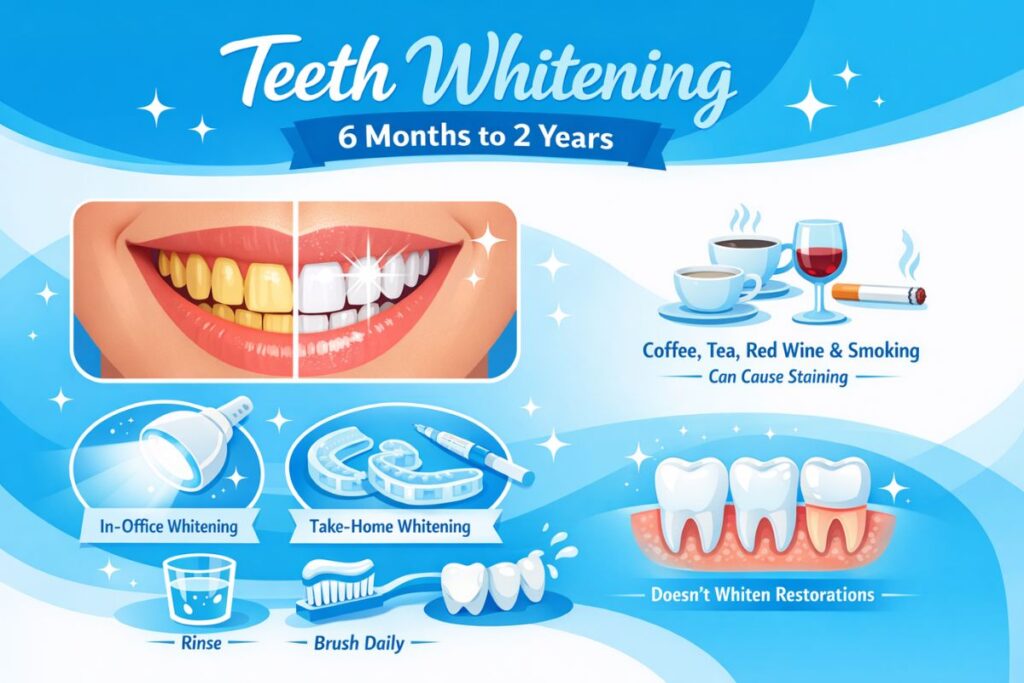
Professional teeth whitening is the most temporary of the cosmetic options, but that doesn’t make it any less worthwhile. Results from in-office whitening typically last between six months and two years, depending on your diet and oral hygiene habits. Take-home whitening trays from your dentist give a similar range, with the added benefit that you can do periodic touch-ups at home to maintain the shade.
The biggest factor that shortens whitening results is surface staining from coffee, tea, red wine, and tobacco. Rinsing with water after consuming these and brushing twice daily with a whitening-compatible toothpaste can help extend the duration of your results. For Phoenix patients who rely on coffee to get through hot mornings or long workdays, this habit is worth building.
It’s also worth noting that whitening works only on natural enamel – not on restorations like crowns, veneers, or bonding. So, if you have any existing restorations, the shade should be discussed with your dentist beforehand to avoid mismatched results.
Dental Bonding: 3 to 10 Years
Dental bonding uses a tooth-colored composite resin applied directly to the tooth surface to repair chips, close small gaps, reshape uneven edges, or mask minor discoloration. It’s one of the most versatile cosmetic procedures available and one of the fastest, often completed in a single appointment.
Bonding typically lasts between three and ten years, with the wide range reflecting how different patients use and care for their teeth. The resin material is durable for normal chewing and speaking, but it’s more susceptible to chipping than porcelain. Biting your nails, chewing ice, or using your teeth to open packaging are the habits most likely to shorten bonding’s lifespan.
When bonding chips or discolors, it’s a straightforward fix. Your cosmetic dentist can repair or replace the bonded area without affecting the surrounding tooth structure.
Enameloplasty: Permanent
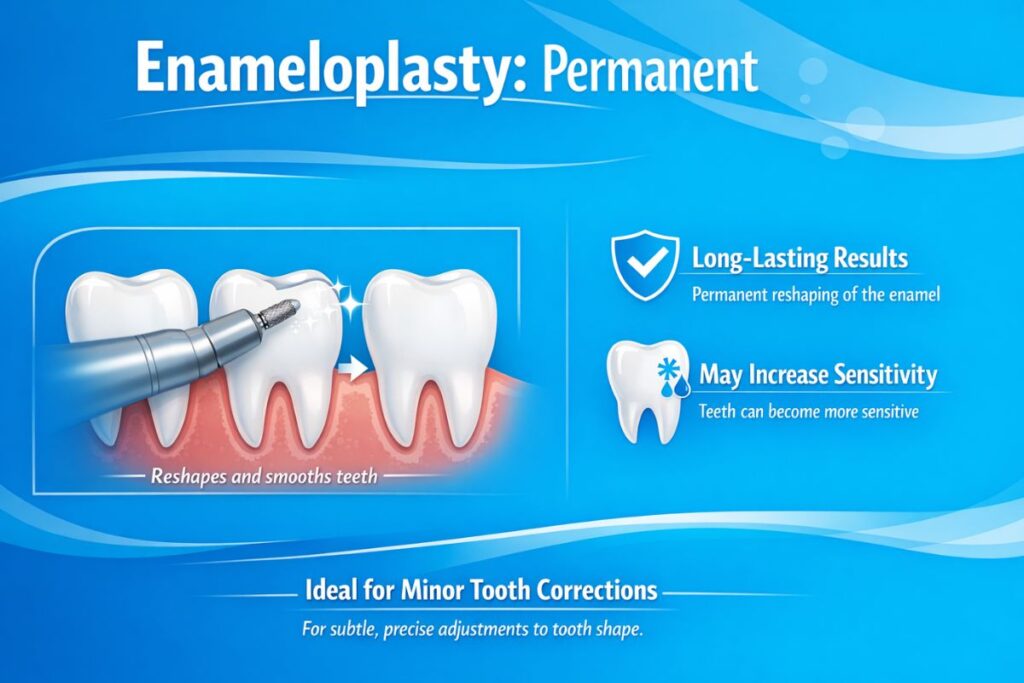
Enameloplasty, or tooth contouring or reshaping, is the removal of a small, precise amount of enamel to smooth rough edges, reduce slight overlapping, or correct minor irregularities in tooth shape. It’s a conservative procedure, and because it permanently removes a thin layer of enamel, the reshaping itself is lasting.
In that sense, enameloplasty has the longest functional lifespan of any cosmetic option – the reshaped tooth doesn’t revert. That said, removing enamel can make the treated tooth more vulnerable to sensitivity or staining over time, which is why enameloplasty is reserved for cases where only very minor corrections are needed. It’s often done alongside bonding to achieve the most refined result.
Veneers: 10 to 20 Years
Porcelain veneers are thin, custom-crafted shells bonded to the front surface of teeth to change their color, shape, size, or length. They’re among the most comprehensive cosmetic solutions available, and with proper care, they last anywhere from 10 to 20 years.
A study found that porcelain veneers have a survival rate of over 90% at 10 years when placed by a licensed dentist on the right candidate. The key qualifiers matter: veneers placed on patients with healthy enamel and good bite alignment last significantly longer than those placed when foundational issues weren’t addressed first.
Because placing veneers requires removing a thin layer of enamel (half a millimeter or less), the procedure is irreversible. When veneers need replacement, you’ll always need veneers or some other restoration covering those teeth. This is the most important thing to discuss during your consultation before moving forward.
To get the most from your veneers, avoid using your front teeth to bite down on very hard foods, wear a night guard if you grind your teeth, and keep up with regular dental checkups. These habits apply whether you’re in Phoenix or anywhere else, but in a city where people are busy and often eat on the go, they’re especially worth reinforcing.
Invisalign: Lasting Results with Retainer Use
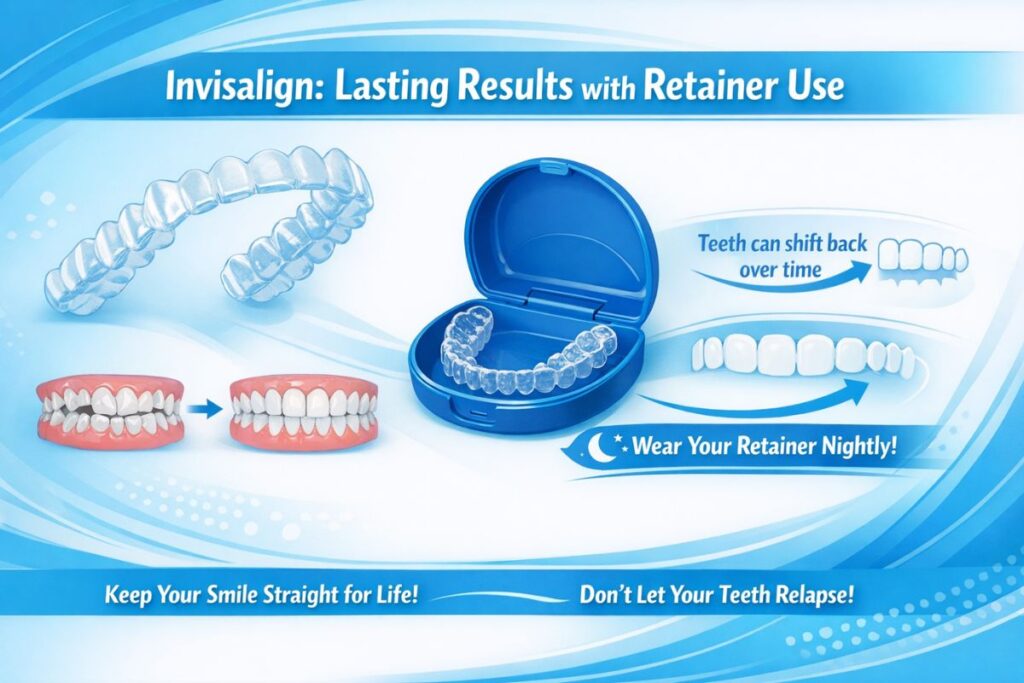
Invisalign uses a series of clear, removable aligners to gradually reposition teeth over the course of treatment, typically lasting 12 to 18 months for adults with mild to moderate cases. The alignment itself can last a lifetime, but only if you wear your retainer as directed after treatment ends.
This is the part that catches people off guard. Teeth have a natural tendency to shift back toward their original positions, especially in the months immediately following treatment. Most providers recommend wearing a retainer nightly indefinitely. Patients who skip wearing a retainer consistently find that their teeth gradually drift back, and the correction they worked months to achieve begins to reverse.
Invisalign also offers a practical advantage for Phoenix’s active population: the aligners are removable for eating, sports, and social events. That flexibility makes compliance easier, and better compliance leads to more predictable, lasting outcomes.
The team at Dental Home Family Dentistry at 720 E Thunderbird Rd understands the concerns Phoenix patients bring through the door. Whether you’re due for a check-in on existing work or exploring new cosmetic options, a consultation is the most direct way to get answers to your situation. You can also reach the office directly at (602) 641-5855.
People Also Ask
1. Does cosmetic dental work affect the health of my natural teeth?
It depends on the procedure. Teeth whitening and Invisalign don’t alter tooth structure at all. Bonding adds material without removing any. Enameloplasty permanently removes a thin layer of enamel. Veneers also require enamel removal. None of these, when done appropriately, compromises the underlying health of the tooth, but they do require good foundational oral health before placement.
2. Can cosmetic treatments be redone if they wear out?
Yes, in most cases. Whitening can be repeated as needed. Bonding can be repaired or replaced relatively simply. Veneers can be replaced with new veneers when they reach the end of their lifespan. Invisalign corrections that have shifted can sometimes be addressed with refinement aligners or a short retreatment. Your dentist will evaluate what makes the most sense at each stage.
3. Does dental insurance cover cosmetic treatments?
Most standard dental insurance plans don’t cover purely cosmetic procedures like whitening or veneers. However, there are exceptions, bonding used to repair a chipped or fractured tooth may be partially covered under restorative benefits, and Invisalign may be partially covered when there’s a documented functional need. It’s worth calling your insurance provider and asking the office to help verify your specific benefits before treatment.
4. How do I know which cosmetic treatment is right for my situation?
The most direct answer is a consultation. Your dentist will review your oral health, discuss your goals, and walk you through which options are clinically appropriate for your teeth. Many patients find that a combination of treatments, for example, whitening followed by bonding, helps them achieve their ideal outcome more efficiently than a single procedure.